Anticipatory Intelligence: A New Field for a World Between Orders
We’ve spent eighteen months building something we couldn’t quite name. Last month at UNGA, the world started asking what to call it. This is our answer.


We’ve been building something for the past eighteen months that’s been hard to explain. When people ask what RAKSHA does, we’ve said “geopolitical intelligence” or “risk analysis,” but those labels never quite captured it. What we’re actually doing doesn’t fit neatly into existing categories. It sits somewhere between research, risk analysis, foresight, and intelligence, but it’s something distinct from all four.
Last month we released the Fracture Atlas 2025 on the sidelines of UNGA. It maps four distinct patterns of structural breakdown across governance, finance, technology, and geopolitics: the kind of shifts that are already reshaping the world but haven’t yet become visible crises. Since then, we’ve been fielding calls from partners, investors, clients, and institutions, all asking variations of the same question: “What exactly is this? What do you call what you’re doing?”
What we do is Anticipatory Intelligence. And it’s the beginning of a new field.
This isn’t theory we’re proposing. It’s a discipline we’ve already been practicing, refining, and operationalising for over a year. The Quiet Fracture Protocol, The Sentinel briefings, the Fracture Atlas - they were all early expressions of the same underlying approach. Now we’re naming it, explaining it, and making the case for why it matters.
Executive Summary
The world’s most consequential shifts don’t announce themselves. They form quietly - in regulatory contradictions, converging technologies, policy incoherence, and subtle realignments of influence, long before they explode into crisis. Yet our dominant knowledge systems remain reactive: research explains the past, risk analysis quantifies threats within known categories, foresight speculates about distant futures, intelligence tracks threats once they emerge. None operate in the most strategically vital terrain: the pre-crisis present, where systems are already bending and the next order is already being negotiated.
Anticipatory Intelligence is a new field built to close that gap. It fuses the empirical rigour of research, the structured assessment of risk analysis, the systemic imagination of foresight, and the disciplined judgment of intelligence into a single practice designed to detect and decode hidden structural reconfigurations in real time. It operates on a simple premise: disruption does not emerge from isolated variables but from convergence zones, where finance collides with law, where infrastructure intersects with geopolitics. Tracking these intersections reveals not what might happen, but what is already unfolding beneath the surface: mapping where systems are fracturing now to anticipate which will rupture into crisis later.
RAKSHA is the first intelligence firm devoted entirely to this discipline. Through the Quiet Fracture Protocol™ (QFP) - a system that maps emerging structural breaks before they escalate, we have operationalised Anticipatory Intelligence into actionable capability. The response to the Fracture Atlas has validated this approach at the highest institutional levels, opening partnerships across corporations, governments, multilaterals, and think tanks globally.
Those who will shape the next order are the ones who can see it forming while it is still fluid. Anticipatory Intelligence is the field built for that reality, and it is already here.
1. A New Field for a World Between Orders
The world is not lurching from crisis to crisis by chance. Today’s upheavals are not sudden shocks. They are structural failures that have been forming quietly, often invisibly, over years. They accumulate in legal loopholes, contradictory policies, shifting financial architectures, and subtle geopolitical bargains. By the time they explode into the headlines, the rupture has already been decades in the making.
Our dominant ways of knowing the world were built for a slower, more predictable age. Research explains what has happened. Risk analysis quantifies threats within known categories. Foresight explores what might happen. Intelligence analyses threats and adversaries once they emerge. But none of these disciplines operate in the most strategically important terrain: the pre-crisis present, the liminal window where systems are already bending, where structures of influence - the architectures that determine who writes trade exemptions, who sets technical standards, who designs regulatory frameworks, are already shifting, and where the next order is already being negotiated beneath the surface.
This paper names the discipline that operates in that space:
Anticipatory Intelligence. It fuses the rigour of research and risk analysis, the horizon of foresight, and the discipline of intelligence into a single practice designed to detect and decode hidden structural shifts while there is still time to shape outcomes. It is about recognition, surfacing the early signals of profound change when action still matters.
Anticipatory Intelligence is the field built for this reality, and RAKSHA is its architect.
2. Why Anticipatory Intelligence Exists
Our knowledge systems assume the world changes incrementally. They presume risk unfolds gradually and institutions can adapt before disruption hits. That assumption is obsolete.
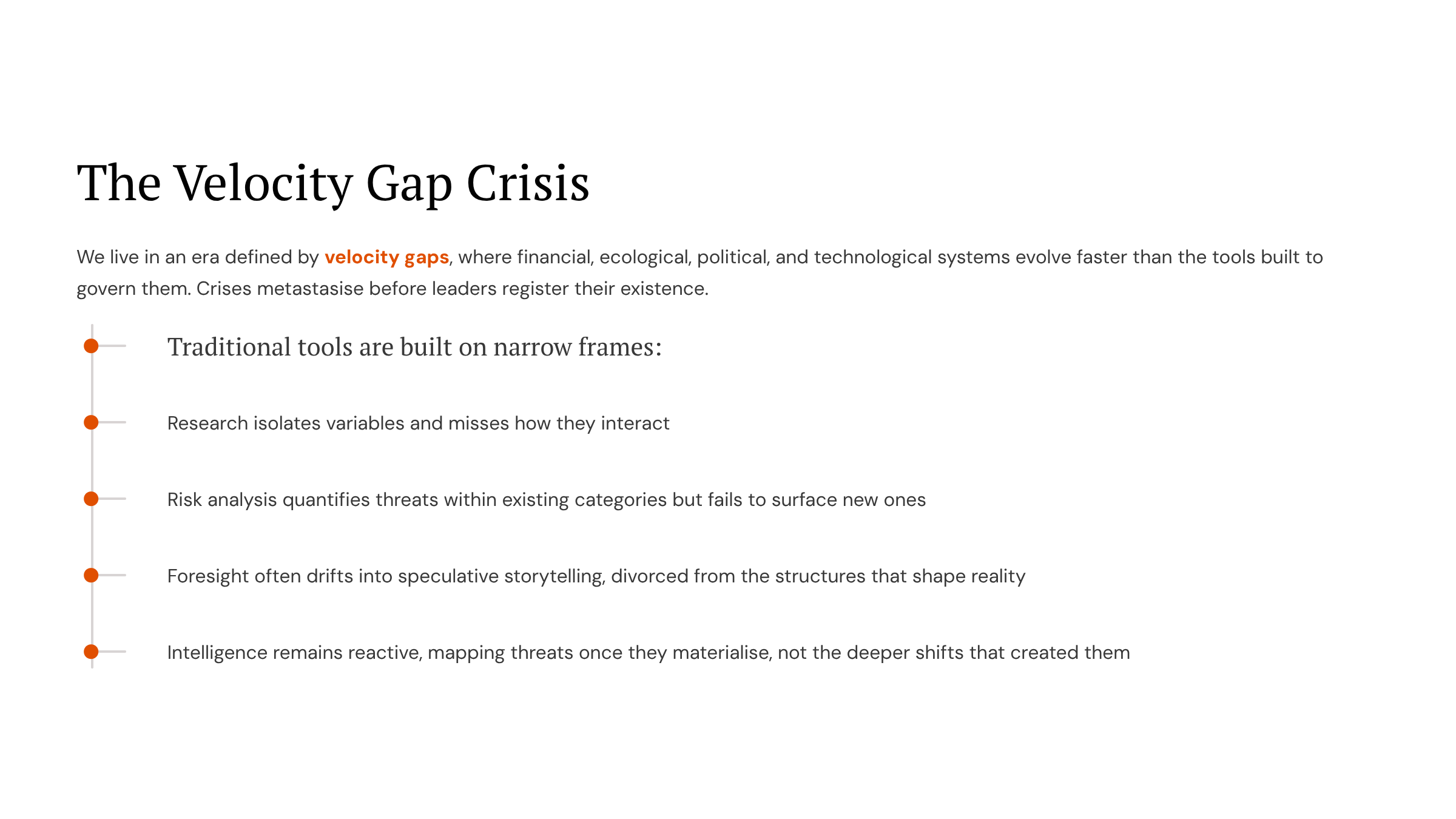
We live in an era defined by velocity gaps: where financial, ecological, political, and technological systems evolve faster than the tools built to govern them. Crises metastasise before leaders register their existence.
Most mainstream efforts, including those by the CIA, Palantir, McKinsey, and Eurasia Group, are heavily oriented toward forecasting: using data to predict discrete future events and generate warnings for decision-makers. They leverage historical patterns, statistical modeling, scenario planning, and machine learning to make probabilistic estimates about when and where a crisis or disruptive incident may occur. This is fundamentally a predictive paradigm that asks “when and where might X happen?” - valuable, but incomplete.
The result is a persistent failure: we keep seeing crises only after they explode. From sovereign debt spirals to infrastructure weaponisation, from algorithmic governance to food system collapse, the signals were visible months, sometimes years, in advance. Our tools simply weren’t built to catch them.
The problem runs deeper than reactive systems. Organizations conflate emerging risks - threats beginning to be recognized now, observable within existing frameworks - with future risks - threats that arise from system configurations that don’t exist today. They assume tracking what’s surfacing now prepares them for what’s genuinely coming. It doesn’t. Major institutions optimize approaches for already-identified risks while remaining structurally exposed to the radically new dynamics the future will actually produce.
Anticipatory Intelligence surfaces the conditions that make those events possible, before any conventional forecast would trigger a warning. It is not about predicting what will happen, but understanding why ruptures will occur, revealing the origins of future disruptions while they are still forming. This is the difference between waiting for statistical signals to reach a threshold and detecting the architectural shifts that will produce those signals months or years later.
It is the difference between analysing an earthquake after it hits, predicting one might happen based on historical seismic patterns, and reading the micro-fractures in the ground months before the faultline ruptures.
Fractures sit in this gap. They are not emerging risks that can be tracked through conventional surveillance. They are the earliest reliable indicators of future risks, revealing when systems are reconfiguring in ways that will create entirely new categories of vulnerability. Fractures are distinct because they reveal systemic reconfigurations: moments when the rules themselves are changing, not just threat levels within existing rules.
Traditional frameworks are built to manage emerging risks. Fractures reveal future risks. The difference is between tracking what you can already see and detecting what is genuinely coming.
Traditional intelligence agencies, consultancies, and think tanks are beginning to recognize this gap. But recognition isn’t capability. Anticipatory Intelligence requires operational systems, analytic protocols, and institutional infrastructure that take years to build. RAKSHA has already built them.
3. The Anticipatory Intelligence Framework
What Anticipatory Intelligence Is
Anticipatory Intelligence is the discipline of detecting, decoding, and acting on hidden structural shifts before they manifest as crisis. It rests on a simple premise: the future is not an unknowable mystery. It is being negotiated now, in competing incentives, contradictory policies, converging technologies, and shifting resource flows.
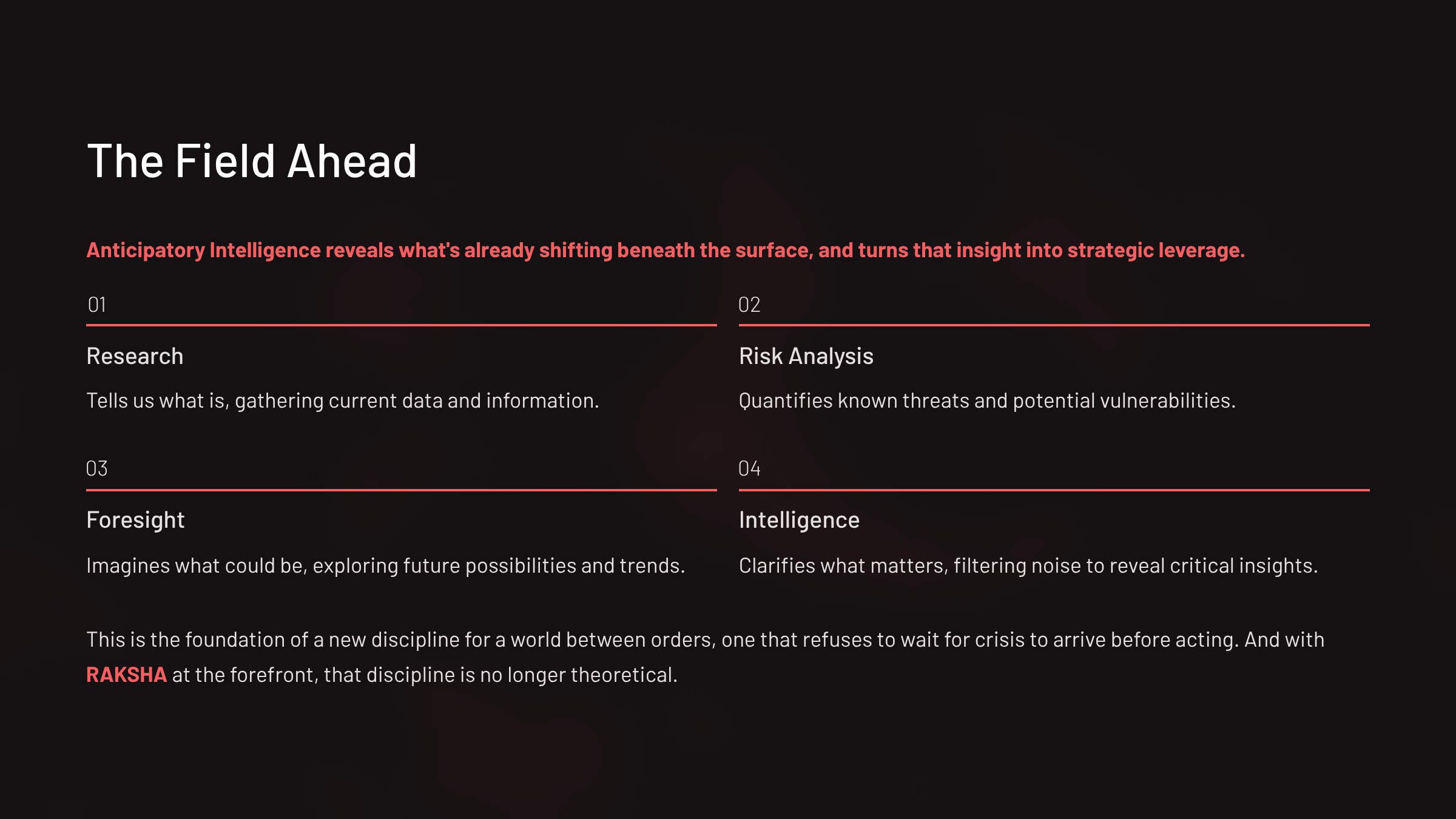
It integrates four traditionally separate practices:
From research, it inherits empirical rigour, grounding analysis in verifiable signals and evidence.
From risk analysis, it inherits structured assessment, but moves beyond quantifying known threats to surfacing entirely new vulnerability categories.
From foresight, it inherits systemic imagination, tracing how interacting forces might unfold over time.
From intelligence, it inherits structured discipline, interrogating assumptions, testing competing explanations, and exposing bias.
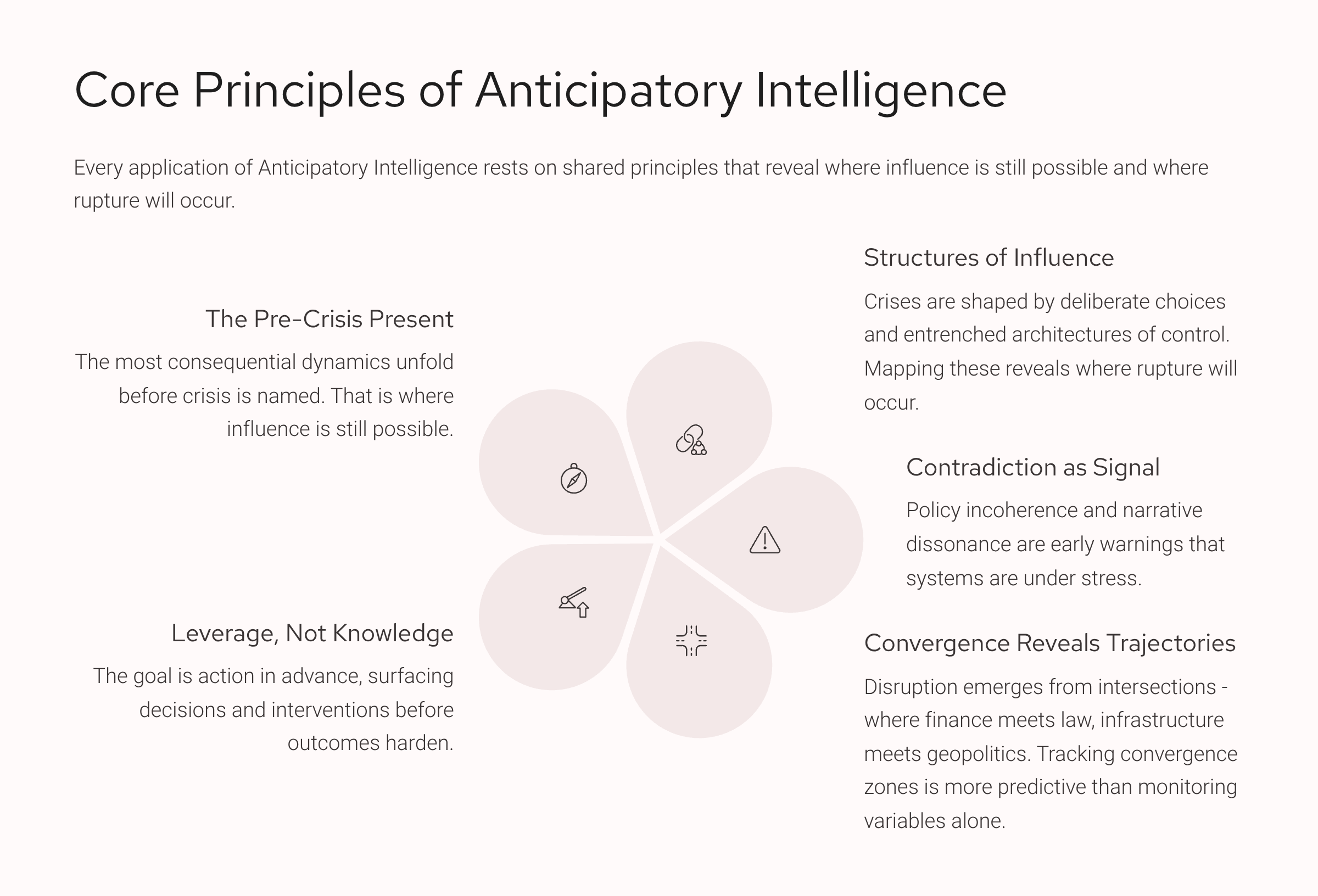
But Anticipatory Intelligence doesn’t stop where those practices end. It uses them as raw material for a deeper aim: to surface leverage points. The moments where early action can redirect trajectories long before rupture becomes inevitable.
Core Principles
4. How Anticipatory Intelligence Works in Practice
Anticipatory Intelligence is an applied discipline already in motion. At RAKSHA, we have operationalised it through multiple systems designed to detect and decode structural shifts in real time.
The Quiet Fracture Protocol™
The Quiet Fracture Protocol (QFP) is the first intelligence system designed specifically to map and interpret emerging structural breaks. Unlike forecasting systems that wait for patterns to reach statistical significance, QFP is built to surface silent signals, the earliest indicators of systemic change that conventional models miss because they don’t yet fit existing threat categories.
Unlike forecasting systems that train models on historical crisis patterns, QFP is built to detect anomalous convergences: combinations of signals that have never occurred together before and therefore have no historical baseline. The system identifies structural contradictions and regulatory arbitrage opportunities that create new system states, not variations of old ones.
QFP combines machine learning, data analysis, and human expertise to scan vast and diverse data streams - regulatory filings, trade flows, legal changes, geopolitical and narrative shifts - and surface fracture signals: subtle signs that a system is under strain or reconfiguring. These signals are then analysed through a structured methodology that identifies fracture convergence zones, points where multiple small shifts interact to produce outsized systemic consequences. The system reveals the architectural changes that will make entire categories of events possible.
5. What Anticipatory Intelligence Enables
The implications of this field extend far beyond early warning. Anticipatory Intelligence enables actors - from investors and governments to multilateral agencies and civil society networks - to act differently with confidence:
Strategic Positioning: Identify emerging structural shifts and reposition early, gaining advantage before markets or policies react.
Risk Mitigation: By seeing fracture points while they are still malleable, design interventions to prevent crises or reduce their impact.
Policy Innovation: Respond not just to symptoms but to the deeper structural dynamics driving instability.
Capital Allocation: Spot where existing systems will fail, and where new ones will emerge, shaping capital flows accordingly.
Governance Reform: Target interventions at the leverage points that will shape entire systems, not just their outcomes.
In short, Anticipatory Intelligence moves decision-making upstream. It shifts the question from “How do we respond once crisis hits?” to “How do we shape the terrain so the crisis never reaches that point?”
6. RAKSHA and the Architecture of a New Field
Every new field needs its first mover. RAKSHA was built to be exactly that. The first intelligence firm devoted entirely to the discipline of Anticipatory Intelligence.
We are not a forecasting platform. We are not predicting when crises will hit. We are mapping the systemic conditions that make crises inevitable, and doing so before those conditions are statistically visible or publicly recognized. Where others wait for signals to reach predictive thresholds, we identify the convergence dynamics and architectural fractures that will produce those signals in the first place. This is not a marginal improvement on existing approaches. It is a fundamentally different operating logic.
We’re building the foundational infrastructure of this field: the data architectures, analytic protocols, operational systems, and institutional partnerships that will power Anticipatory Intelligence for decades. The Quiet Fracture Protocol is the first operational system. The Fracture Atlas demonstrated institutional demand at the highest levels.
What comes next is the platform that makes this capability scalable, defensible, and indispensable. We’re now expanding that infrastructure globally, building the networks and systems that will make Anticipatory Intelligence the standard for strategic decision-making. But we’re not stopping at analysis. We’re building the operational capacity that will power this discipline for the next generation.
The actors who will hold influence in the decades ahead are those who can see the next order forming while it is still fluid, and act before it hardens. Anticipatory Intelligence is the discipline built for that reality. And RAKSHA isn’t waiting for others to recognize it. We’re defining it, building it, and operationalising it now, before the window closes.
Interested to know more?
Email: hello@rak-sha.com | www.rak-sha.com